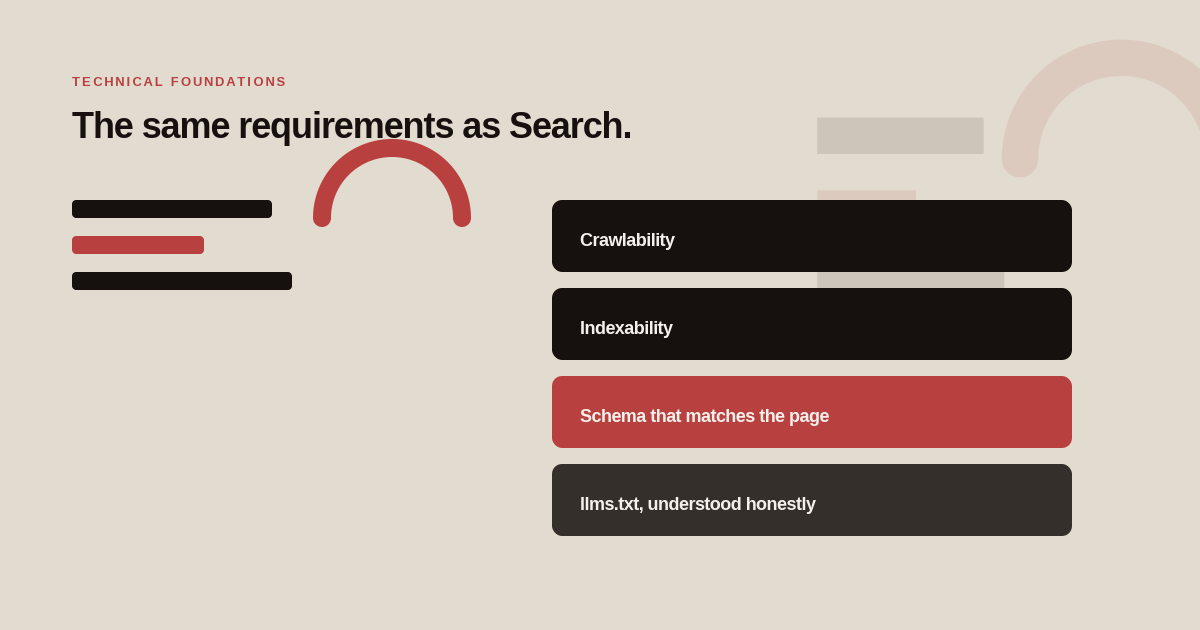
Most of what makes a site visible in AI answers is the same technical hygiene that makes it visible in classic search. That is not a slogan. It is Google’s published position. This article covers the foundations worth doing, and it is honest about a file you will hear a lot about: llms.txt.
Crawlability and indexability
Google’s AI features documentation says a page must meet the ordinary technical requirements for Search: Googlebot must not be blocked, the page must return an HTTP 200 status, and the content must be indexable. If those fail, the page is not eligible as a supporting link in AI Overviews or AI Mode.
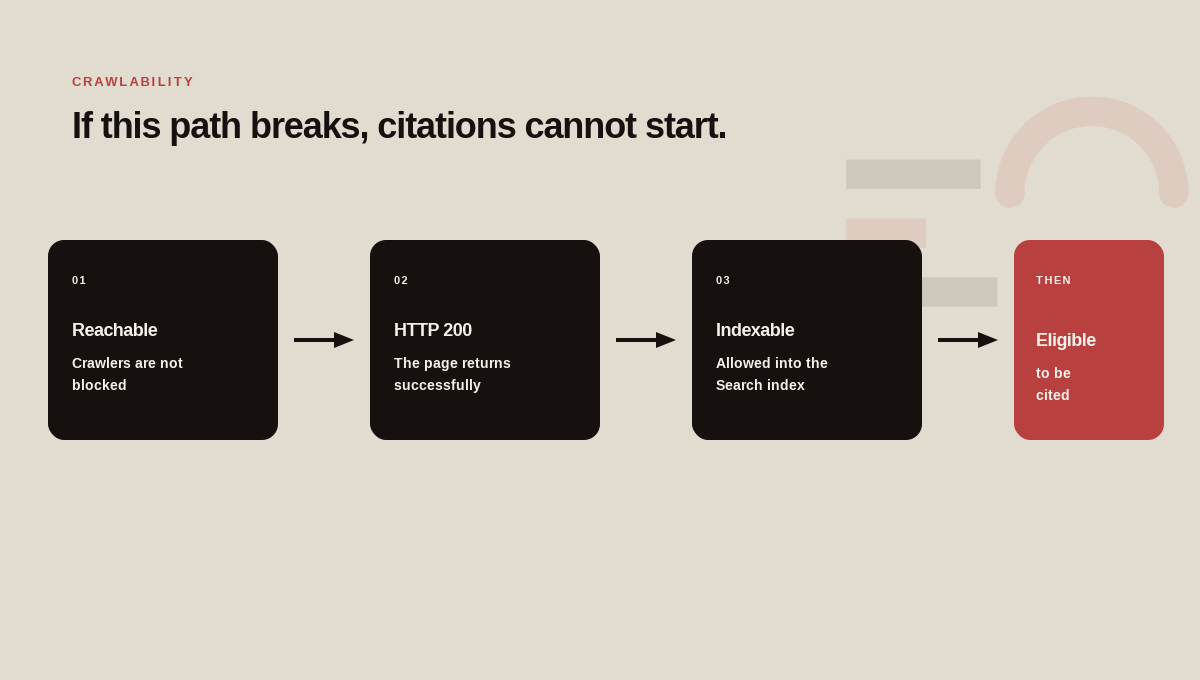
A practical pass for a South African business site looks like this:
- Check robots.txt. Do not disallow the pages you want found, and do not block Googlebot by mistake.
- Confirm important URLs are in your sitemap and that the sitemap is listed in robots.txt.
- Use Search Console’s URL Inspection tool to see what Googlebot actually received.
- Keep the main content in HTML text. If the answer only appears after a script runs, you are taking a risk.
- Fix broken redirects, soft 404s and duplicate URLs so each important idea has a clear home.
For ChatGPT search, OpenAI’s crawler documentation asks you to allow OAI-SearchBot in robots.txt if you want to be considered in ChatGPT search answers. GPTBot is a different control, used for training foundation models, and can be allowed or disallowed separately.
Structured data, used honestly
Schema markup can help machines understand a page: an article, a service, a FAQ, an organisation, a person. Google’s advice, including in John Mueller’s May 2025 post on succeeding in AI search, is to make sure structured data matches the visible content and that you follow the usual guidelines and validation.
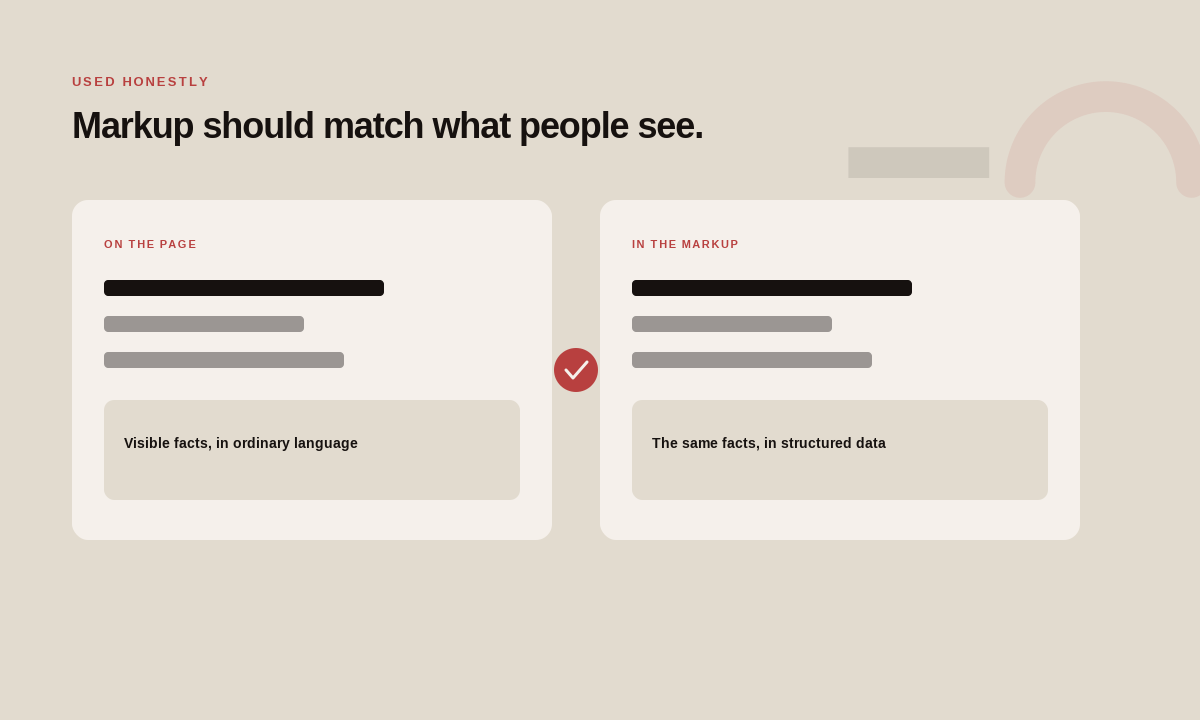
Just as important is what Google says you do not need. In AI features and your website, Google writes that you do not need to create new machine-readable files, AI text files, or markup to appear in AI Overviews or AI Mode, and that there is no special schema.org structured data you must add for those features. Use schema where it describes what is already on the page. Do not invent a hidden “AI layer” that the visitor cannot see.
What llms.txt actually is
/llms.txt is a community proposal for a Markdown file at the root of a site, intended to help large language models find useful pages. It was proposed by Jeremy Howard of Answer.AI in September 2024, and the proposal is published at llmstxt.org and in Answer.AI’s post, /llms.txt, a proposal to provide information to help LLMs use websites.
It is not an official Google, OpenAI or W3C standard, and it is not a confirmed ranking factor for Google AI Overviews. Google’s documentation, quoted above, says you do not need a special AI text file to appear in those features. Some documentation hosts generate an llms.txt file as a convenience for tools that choose to read it. That can be harmless. It should not be sold as a requirement, and it will not repair a site that Google cannot crawl or that has nothing useful to say.
If you add one, treat it as a clear table of contents in Markdown: who you are, which pages are canonical, and where the important facts live. Then go back to the work that official guidance actually supports: crawlability, indexable text, and structured data that matches the page.
A AI Search Visibility Audit reviews these foundations alongside your actual visibility in AI answers. For implementation help, see technical SEO audits and contact.
Sources
- Google Search Central, “AI features and your website”, last updated 10 December 2025: developers.google.com/search/docs/appearance/ai-features
- John Mueller, “Top ways to ensure your content performs well in Google’s AI experiences on Search”, 21 May 2025: developers.google.com/search/blog/2025/05/succeeding-in-ai-search
- OpenAI, “Overview of OpenAI Crawlers”: developers.openai.com/api/docs/bots
- Jeremy Howard, Answer.AI, “/llms.txt, a proposal to provide information to help LLMs use websites”, 3 September 2024: answer.ai/posts/2024-09-03-llmstxt.html; proposal site: llmstxt.org
Want this checked on your own site?
The AI Search Visibility Audit reviews how your brand appears in Google AI Overviews, ChatGPT, Perplexity and Gemini, then gives you a prioritised plan. It costs R6,500.00 and typically takes 5 to 7 working days. You can also send an enquiry or book a 20-minute call.